

Most proposals from an outdoor lighting company in Midlothian, VA list a fixture count and a price. The parts that decide whether the system still looks right in year five sit underneath that line: transformer capacity, wire gauge, the length of each run, the housing material and who comes back when a fixture fails. None of it shows in a rendering.
Josh Goff started Commonwealth Curb Appeal in 2004, and our team now designs and builds complete outdoor living spaces across the Richmond area, with lighting planned as part of the full design rather than added at the end. Every design visit includes a 3D LiDAR scan of the property’s existing elevations, utilities and conditions, so a lighting plan is drawn against the real site rather than a sketch.
That matters more for lighting than for almost anything else we build, because a scheme is designed around what a beam will actually hit at eleven at night. This guide covers what a lighting system includes beyond the fixtures, how the electrical side is sized, which choices hold up through a Virginia year, and what a homeowner should insist appears in writing.
Related: Transform Your Backyard: Pergola and Outdoor Lighting Solutions for Richmond, VA and Midlothian, VA
What Does an Outdoor Lighting Company Install Beyond the Fixtures?
Beyond the fixtures, an outdoor lighting company installs the transformer, the cable runs leaving it, the connections at every splice and the burial detail that keeps all of it out of a shovel’s way. Homeowners see the fixtures, the lamps and the light they throw, but those four hidden parts decide how long the system lasts.
Connections are where most failures begin. A system joined with pierce-point connectors works on handover and corrodes over a few damp Virginia winters, while silicone-filled or heat-shrink connections resist the moisture doing the damage. The difference costs very little on installation day and a great deal in year four.
Burial depth and routing matter for the same reason. Cable laid shallow across a lawn is cable a core aerator or a shrub replacement will find. A well-planned installation routes runs along bed edges and hard surfaces where they can be located later, and sleeves any run crossing under paving.
The design work sits on top of all of it. Deciding which tree gets a moonlight fixture in its canopy, which wall gets grazed and which path gets nothing at all separates a lit property from a bright one. Our lighting designs cover path lighting, uplighting on trees and architecture, step lighting, string light systems and task lighting for outdoor kitchens, and each starts with those placement choices.
How Is a Low Voltage Transformer Sized, and Why Does It Matter?
A low voltage transformer is sized to carry the full connected load of the fixtures with real headroom to spare, because a unit running at its ceiling runs hot and ages fast. It converts household current to the twelve to fifteen volts the fixtures run on, and its capacity is measured in watts.
Headroom is also what makes the system expandable. A property that adds a pavilion, a planting bed or a seating area two years later wants to extend the existing system rather than install a second one, and that only works where the original transformer was specified with room to grow.
Multiple taps are the other piece. A transformer with several voltage taps lets long runs be fed at a higher tap to compensate for the voltage they lose along the way, so a fixture at the far end of the property delivers the same color and brightness as one beside the house.
What Does Wire Gauge Change Over a Long Lighting Run?
Wire gauge controls how much voltage a run loses before it reaches the last fixture, and the longer and thinner the cable, the more it drops. A fixture receiving ten volts instead of twelve does not fail; it dims and shifts warmer, which is why one corner of a property can look tired while the rest looks right.
Heavier gauge cable costs more per foot and solves the problem permanently. On a large Midlothian property with runs reaching several hundred feet, a heavier gauge on the long legs is a standard specification and a common omission on lower bids.
How Does Cable Layout Affect Voltage Across a Property?
Cable layout decides how evenly voltage arrives at each fixture. A single long daisy chain starves its far end, while splitting the property into shorter legs, or running a hub configuration with each fixture fed on its own tail, costs more cable and delivers a consistent result.
That is a design decision made before trenching, not after. Reconfiguring a run once beds are mulched and the patio is set means opening ground that was finished, which is the practical reason the cable plan belongs on the drawing alongside the fixtures.
Which Outdoor Lighting Fixtures Hold Up Through a Virginia Year?
Cast brass and copper fixtures hold up longest, since they develop a patina and keep working. Powder-coated aluminum performs well until a trimmer chips the coating, after which the exposed metal corrodes. Thin stamped housings sold in kits tend to fail at the gasket within a few seasons.
Lamp choice sets the character. Warm color temperatures flatter brick, stone and foliage, while cooler lamps read blue against the same materials and turn a planting bed gray. Beam angle is the other half: a narrow spot for a specimen tree, a wide flood for a wall, and a shielded path light that puts light on the ground rather than in a visitor’s eyes.
Serviceability deserves a question of its own. Integrated LED fixtures are sealed units, so a failure means replacing the whole fixture, while a fixture with a replaceable lamp can be serviced for the cost of a lamp. Both are legitimate choices, and a homeowner should know which one they are buying.
Related: What’s Missing From Your Midlothian, VA, Backyard? Thoughtful Landscape Lighting
How Should a Lighting Plan Treat a Pavilion or Covered Space?
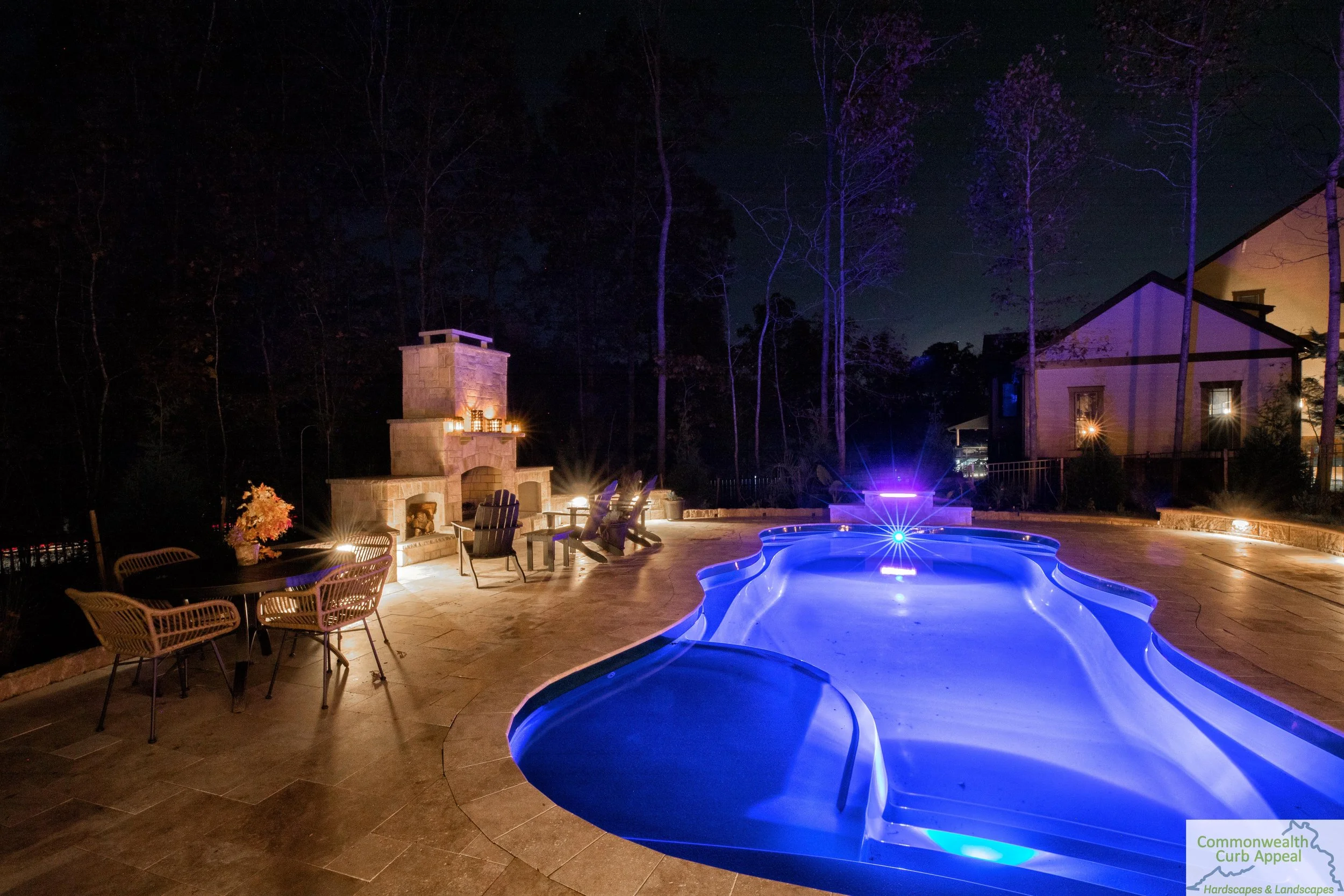
A covered structure needs three layers of light: overhead light inside the roof for the table, perimeter light at the cap or beam line to give the structure shape across the yard, and task light under a counter or along a bar to make the space usable rather than merely visible.
Running all three on one switch is the usual mistake. Separate circuits let a pavilion run bright for cooking and low for sitting, and a homeowner uses the space far more often when it can do both. Splitting circuits belongs at the planning stage, because adding a separate circuit later means opening a finished ceiling.
A structure also changes the rest of the scheme. A lit pavilion is a bright object in a dark yard, so everything around it has to come up slightly or the surroundings read as a black wall. Balancing that is a judgment made on site after dark, and our pavilion design and construction work carries the lighting layers from the first drawing.
What Should an Outdoor Lighting Proposal Put in Writing?
An outdoor lighting proposal should put five items in writing: the fixture make, model and finish; lamp wattage, color temperature and beam angle; transformer capacity against the connected load; the cable gauge on each run; and the warranty, separated into what the manufacturer covers and what the installer covers.
The installer half is the one homeowners overlook. Commonwealth Curb Appeal warrants its low voltage lighting systems against workmanship defects for ninety days, and knowing that number is more useful than a vague assurance, because it tells a homeowner exactly what to confirm with any company bidding against us.
A proposal that lists a fixture count and a lump sum is not comparable with one that lists all five. Asking two companies for the same five items turns two unrelated numbers into a decision a homeowner can actually make.
Why Does Outdoor Lighting Get Aimed After Dark?
Outdoor lighting gets aimed after dark because beam spread, glare angles and light spill are invisible in daylight. A fixture set at two in the afternoon is set by guesswork, including how light falls across bark or brick and the point where a spill of light becomes a nuisance to a neighbor.
Fixtures get rotated, tilted, shielded and in some cases relocated during a night aiming visit, because the plan predicted what the light would do and the night shows what it actually does. A system that skipped this step is the one with a tree lit from the wrong side and a glare bomb beside the front steps.
Seasonal change argues for a follow-up as well. Foliage that blocked a beam in August is gone in December, and a fixture aimed through a full canopy reads very differently once the leaves drop. Our periodic maintenance visits adjust fixture angles as plantings grow and change.
Where Should Landscape Lighting Go on a Midlothian Property?
Landscape lighting belongs on three or four focal points, with everything else left to recede, because contrast needs darkness as much as it needs light. A property with every tree uplit and every path edged in fixtures reads as a parking lot.
A strong design starts from the view, usually from the kitchen window and the main seating area, and works out what should hold the eye from there. A specimen tree, a stone wall face, the pavilion and the water are the usual candidates. Everything else earns its fixture by making one of those read better.
Glare is the discipline that keeps it from going wrong. A fixture a person can look directly into destroys their night vision and flattens the whole scheme, so path lights get shields, uplights get louvers or sit behind planting, and anything aimed near a sightline gets tested from where people actually sit.
Neighbors set the last boundary. Light crossing a property line is a complaint waiting to happen, and on the closer lots around Midlothian a wide flood aimed at a boundary tree can throw as much light next door as it does at home. Shielding and beam angle solve it at the design stage rather than after the conversation.
How Does Outdoor Lighting Work With the Hardscape Around It?
Outdoor lighting and hardscape belong in one design, because recessed fixtures set into a seat wall cap, a step riser or a column have to be positioned while the masonry is built. The sleeve and the cable path run inside the structure.
Steps are the clearest case. A riser light set during construction disappears into the wall and lights the tread cleanly. The same effect added afterward means surface-mounting a fixture and running cable where it can be seen, which rarely looks deliberate.
The surface itself changes the result. A light gray travertine deck bounces light and needs less of it, while a dark charcoal paver absorbs light and needs more, placed closer.
Fixture spacing belongs to the actual material going down rather than a standard interval, which is why our custom paver patio projects specify the lighting alongside the pavers.
What Maintenance Does a Low Voltage Lighting System Need?
A low voltage lighting system needs one short annual visit to reset aim, clean lenses and clear plantings away from fixtures. Fixtures drift out of aim as soil settles and roots move, lenses cloud with pollen and hard water, and beds grow over path lights within two seasons.
Controls are worth revisiting too. A timer set in June has the wrong schedule by November, and an astronomic timer or photocell that tracks sunset removes that chore entirely. Our LED systems can also run on a smartphone app, which handles the schedule and lets a homeowner change the light color to suit the evening.
Expansion is the pleasant part of maintenance. A system specified with headroom accepts a new bed, a new structure or a new seating area without starting over, which is the practical payoff for the transformer sizing decision made at the beginning.
Our outdoor kitchen design and construction work plugs into the same system where the headroom allows it.
Plan Your Outdoor Lighting Around What the Property Does After Dark
A lighting scheme is a set of judgments about what a yard should look like at night, and those judgments are far easier to make with the real site in hand.
Our designer meets with you to learn your style and how you use the space, and the LiDAR scan gives the lighting plan an accurate base to build from.
Commonwealth Curb Appeal designs outdoor lighting systems for Midlothian, VA homes as part of the full outdoor living plan. Schedule your outdoor lighting consultation with Commonwealth Curb Appeal.
In Summary
How long does a low voltage lighting installation in Midlothian, VA take?
Most residential systems take one to three days to install once the design is approved, because the work is trenching, cable runs, connections and fixture setting rather than heavy construction. Final aiming happens separately, after dark, on a return evening.
Can fixtures be added to an existing lighting system later?
Fixtures can be added later when the original transformer has headroom and the cable runs are still accessible. Where a transformer was filled to capacity on day one, adding fixtures means a second transformer or a rebuild, which is why a system should be sized for growth at the start.
What does the Commonwealth Curb Appeal lighting warranty cover?
Commonwealth Curb Appeal warrants its low voltage lighting systems against defects in workmanship for ninety days, taking effect from the final invoice once the project is paid in full. Fixture and lamp failures fall under the manufacturer’s own warranty, which varies by product, so the proposal separates the two.
Related: Create a Magical Ambiance for Fall Dinner Parties With Custom Outdoor Lighting in Richmond and Tuckahoe, VA
